
FREE RESOURCE | LAB STARTUP PLAYBOOK
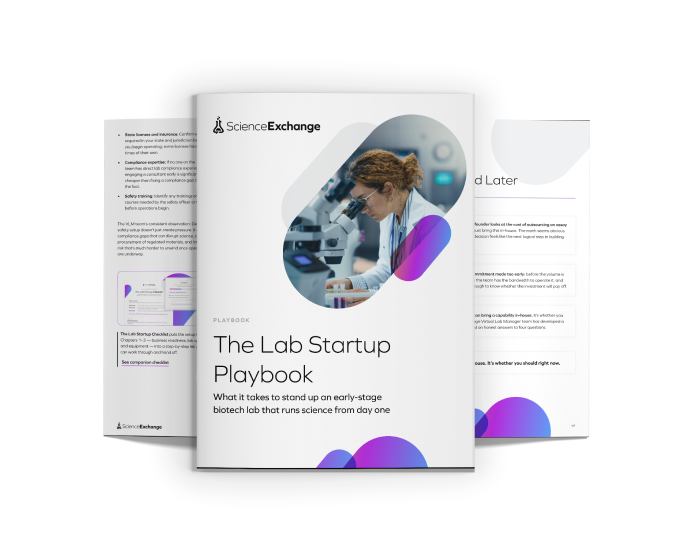
The Lab Startup Playbook
Most founders building their first lab expect the hard part to be the science. What actually determines your speed to first data is everything that happens before any science starts at all — the accounts, approvals, and systems most teams don't think to plan for.
Built from what the Science Exchange Virtual Lab Manager team sees at nearly every early-stage lab launch, this guide walks through the four phases of standing up a lab that runs from day one: getting the business ready to buy, getting the space ready for equipment, building the smallest lab your first experiment requires, and deciding what to keep in-house versus send out.
Get the Playbook
The mistakes that cost early-stage labs the most time aren't scientific — they're operational.
A missing W-9 holds up a first shipment. An approval structure no one defined before a contract needed signing. A liquid nitrogen account that should've been opened six weeks earlier. None of these are hard problems on their own, but each one costs days, and the days compound.
This guide cuts through that. It lays out exactly what to have in place before your first order ships, what to build versus outsource, and how to avoid the equipment lead times and infrastructure gaps that turn a four-week launch into a twelve-week one.
What's Inside

The Business Readiness Checklist
The documents, inboxes, and approval structures every supplier will ask for — plus the purchase order and budget systems that prevent ordering delays before they start.

The Lab Space Logistics Audit
What to check before equipment arrives: loading dock access, elevator dimensions, electrical capacity, and the utility and gas account timelines that routinely take four to six weeks.

Building Your Minimum Viable Lab
How to identify the equipment and consumables your first experiment actually requires, spot long-lead-time items before they become bottlenecks, and avoid tying up capital in gear you won't need for months.

The Outsource vs. Build Framework
A four-question framework — volume, frequency, turnaround, and customization — for deciding when to send work to a CRO and when a capability is worth bringing in-house.
Frequently Asked Questions
What is the Lab Startup Playbook from Science Exchange?
It's a free guide from the Science Exchange Virtual Lab Manager team that walks founders and lab managers through the four phases of launching an early-stage biotech lab: business readiness, lab space setup, building a minimum viable lab, and deciding what to outsource versus build in-house.
Who is the Lab Startup Playbook for?
Founders, scientists moving into operational leadership, lab managers, and R\&D ops leads standing up an early-stage biotech lab, whether they've done it before or are figuring out the operational side for the first time.
What documents does a new biotech lab need before placing its first order?
Common requirements include a W-9, business license, lease agreement, and credit reference letter, along with a dedicated purchasing inbox and accounts-payable inbox to keep vendor communication and invoicing organized from day one.
How long do utility and gas account setups take for a new lab?
Utility and gas accounts — including liquid nitrogen and dry ice supply — routinely take four to six weeks to establish, so the playbook recommends starting these the day a lease is signed rather than waiting until equipment arrives.
What is a "minimum viable lab"?
It's the smallest set of equipment and systems needed to run a lab's first experiment, avoiding both overbuying equipment that sits unused and underplanning for long-lead-time items that end up blocking a launch.
How do I decide whether to outsource a capability or build it in-house?
The playbook's framework scores the decision across four factors — volume, frequency, turnaround time, and customization — and recommends outsourcing by default until real usage data justifies bringing a capability in-house.