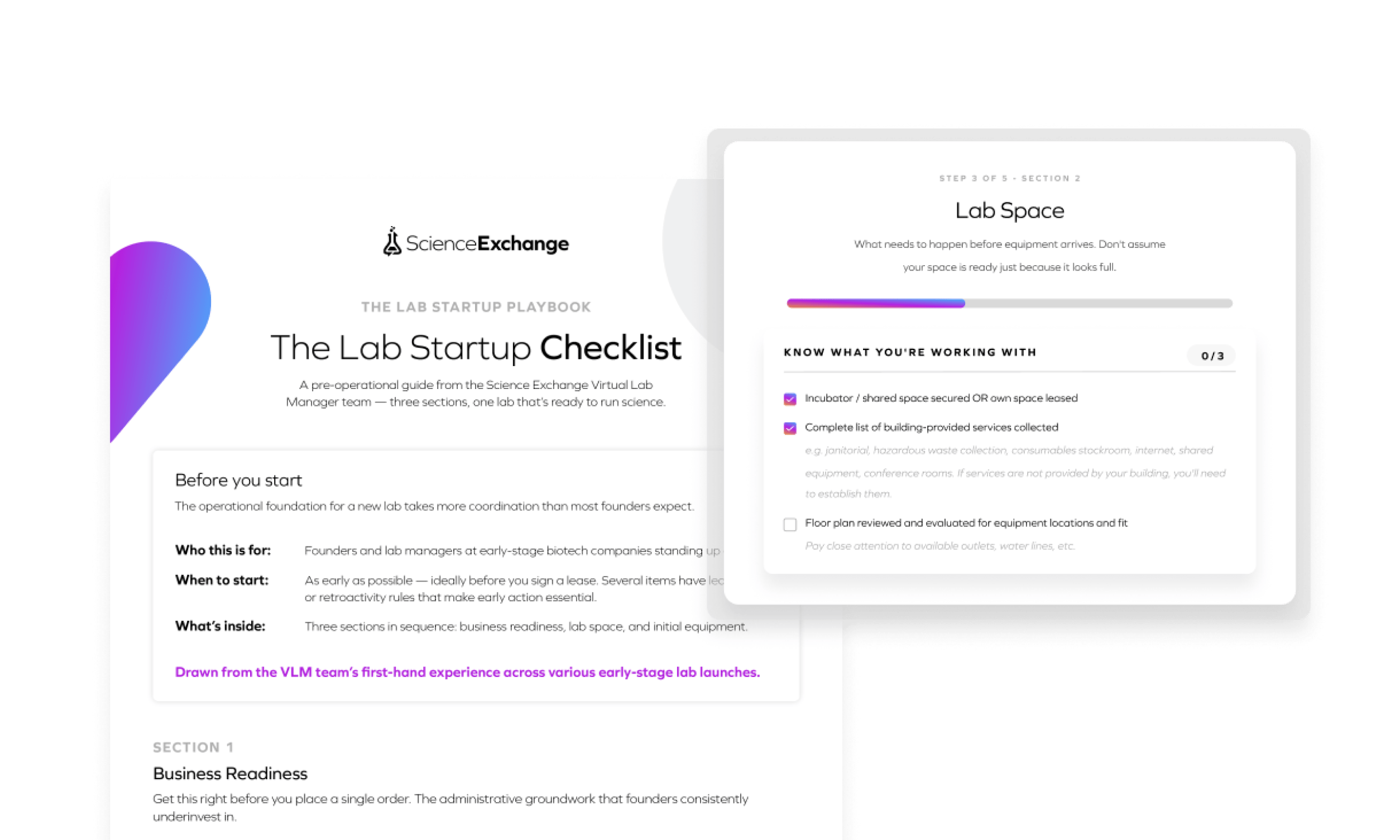
The Lab Startup Checklist puts the setup from Chapters 1–3 — business readiness, lab space, and equipment — into a step-by-step list you can work through and hand off.

What it takes to stand up an early-stage biotech lab that runs science from day one
From the Science Exchange Virtual Lab Manager team
Virtual Lab Manager is a scientist-led service that embeds a dedicated lab operations and procurement specialist into an early-stage biotech, handling sourcing, purchasing, supplier relationships, spend visibility, and compliance, so scientists can stay focused on the science. The team works with biotech companies from their earliest days, and everything comes from what they see work, and what they see go wrong, as new labs get off the ground.
Download the full playbook to read offline or share with your team.
Most founders building their first lab expect the hard part to be the science. What catches them off guard is how much of a lab’s early speed is decided before any science happens at all.
The most common problems the Science Exchange Virtual Lab Manager team encounters at lab launches aren’t scientific ones. They’re a missing W-9 that holds up a first shipment. An approval structure no one defined before a contract needed signing. A liquid nitrogen account that should have been opened six weeks earlier. None of these are hard problems, but each one costs days or weeks, and at an early-stage company, those weeks are the difference between getting to data and burning runway waiting for it.
Systems — the accounts, approvals, documents, and decisions that sit underneath the science — are unglamorous and easy to defer. They’re also what determine whether your first experiment runs in week four or week twelve.
This guide is organized the way a launch actually unfolds:
This guide is written for the people standing up an early-stage lab: founders, scientists moving into operational leadership, lab managers, and R&D ops leads. It assumes you’re figuring out the operational side largely on your own, and it’s written to be useful whether or not you’ve done this before.
Start as early as you can. Several items here (gas and utility accounts, tax exemption certificates, long-lead equipment) have timing rules that can’t be compressed later, so the guide is most valuable before your first order ships, not after.
The four chapters run in the order a launch unfolds, so reading start to finish maps to the sequence you’ll actually face. Each one also stands alone: if you’ve already handled business setup and just need to think through equipment, Chapter 3 works on its own.
Two companion tools turn the guide into action:
The Lab Startup Checklist puts the setup from Chapters 1–3 — business readiness, lab space, and equipment — into a step-by-step list you can work through and hand off.

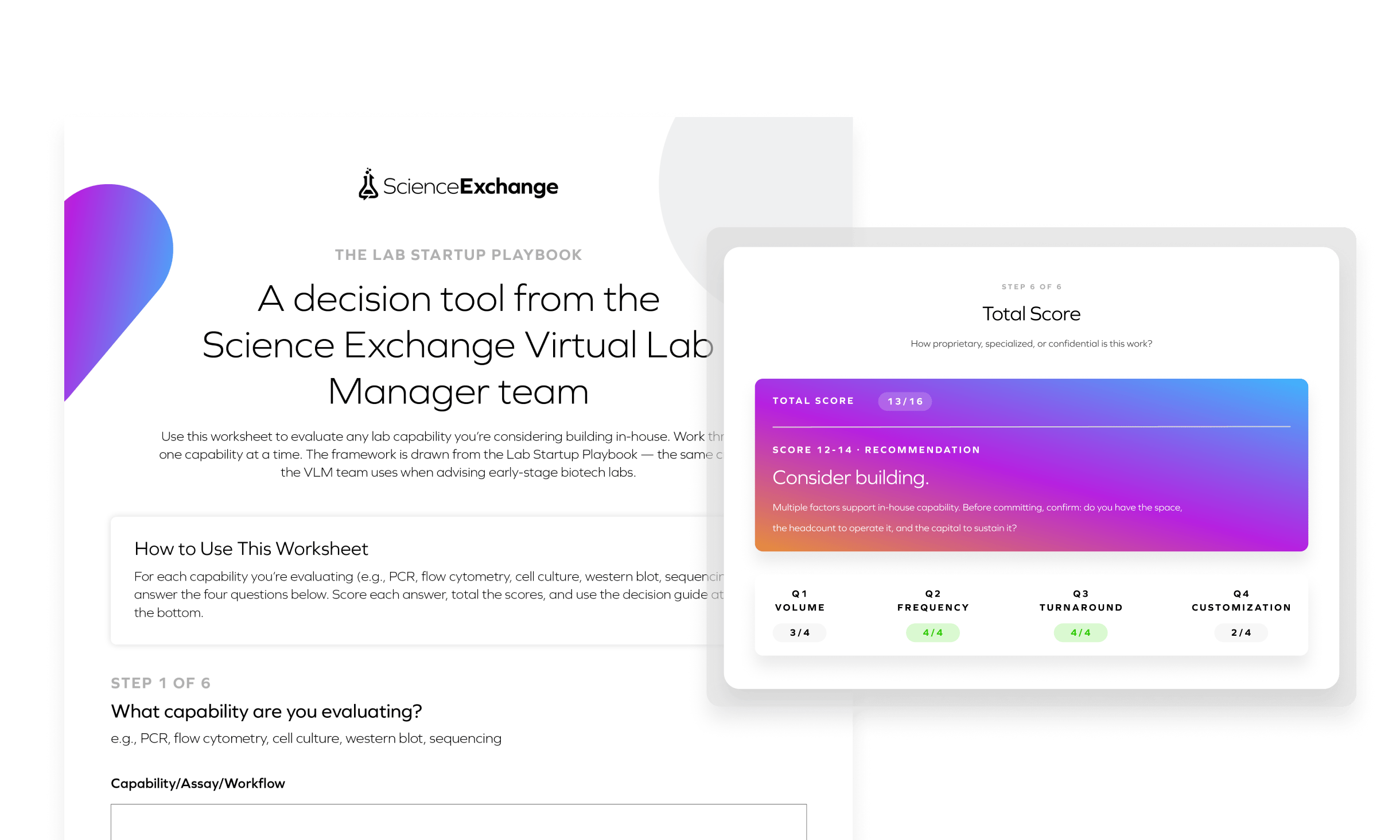
The Outsource vs. Build Worksheet applies the Chapter 4 framework to any capability you’re weighing, scoring it across volume, frequency, turnaround, and customization.
Chapter 1
Most biotech founders might assume the hardest part of starting a lab is finding the right centrifuge. However, the part to focus on is almost never the equipment.
The mistakes that cost early-stage labs the most time and money aren’t scientific, they’re operational. When operations infrastructure is missing, every order becomes a fire drill. A missing tax form holds up a shipment, invoices sit in inboxes with no clear owner, or your accountant or investors ask for a PO history that doesn’t exist. Each of these gaps costs days, and the days compound. The Science Exchange Virtual Lab Manager team has watched each of these stall launches, and every one of them is preventable.
Getting business infrastructure right before your first order ships is one of the highest-leverage investments you can make in your lab’s operational velocity. It’s also the part of the lab setup that most founders underinvest in, because it doesn’t feel like science. Here’s what to get right before you set foot in the lab.
Your suppliers (CROs, core facilities, lab supply companies, and more) will ask for the same set of documents repeatedly. Have these on file and ready to share before you place your first purchase:
If you are based in an incubator, confirm what goods and services are provided by the incubator and what are your responsibilities to cover. The answer matters when a supplier asks and you need it the same day.
R&D purchasing takes real, dedicated time, and at most early-stage labs, no one has been formally assigned to own it yet. That gap is fine at first, but it needs to close before your first order ships.
Three things need to be in place: a clear inbox, a clear paper trail, and a clear owner. Set all three up before that first order goes out. Reconstructing them later is much harder than maintaining them as habits.
If the answer to “who approves this purchase?” is “whoever is available” or “we’ll figure it out,” that’s a delay waiting to happen.
Approval bottlenecks are one of the most common causes of ordering delays in early-stage labs. What happens if a founder is traveling, a finance lead wasn’t looped in, or a contract is progressing at a much higher price than anticipated? Define thresholds, assign roles, and document the process before you’re in a situation where an order or contract is waiting on it.
For labs just getting started, this doesn’t need to be complicated; it may be as simple as assigning one person the responsibility for keeping the budget on track. The goal isn’t bureaucracy, it’s for operations to continue even when key people are unavailable.
An operating budget tells you what you have to work with overall. Project-level budgets tell you whether a specific experiment or study is on track or consuming more than it should.
Labs that only track the top line lose visibility into which projects are driving disproportionate spend. Labs that only track at the project level can miss overall burn signals until it’s too late to course-correct.
Set your operating budget before your first major procurement cycle. For any experiment or CRO engagement with material cost, assign a project-level budget before work begins.
Many states offer sales tax exemptions for equipment and supplies used in R&D activities, and early-stage biotech organizations are frequently eligible, particularly in states with established life sciences industries like California, New York, Massachusetts, Texas, and New Jersey. Whether your organization qualifies depends on your state, your entity type, and how the purchases are used. Confirm eligibility with your accountant or finance lead before placing orders.
Exemption certificates generally cannot be applied retroactively. Orders placed before your certificates are on file are typically charged at full tax, money you won’t automatically recover. Work with your accountant to file state exemption certificates before placing orders, then register your exemption status with each major distributor.
If you’ve already placed orders without exemption certificates in place, ask your accountant whether a refund claim is available. Some states allow this for qualifying past purchases, but it varies.
Major distributors including Thermo Fisher and VWR run new lab and startup discount programs that offer real savings on initial orders and are a fast path to establishing your primary distributor relationship. Most early-stage teams either apply too late or miss this opportunity completely.
Apply as soon as your business documents are in order. Applications are easy and typically only take a minute of your time. Also worth exploring: trade group memberships affiliated with major distributors, which can unlock additional pricing and benefits.
The application process is straightforward. The window to qualify as a “new” account is finite. Apply early.
The Payoff
The infrastructure that enables fast science isn’t glamorous. It is, however, what decides how quickly you get from a signed lease to a first result.
The Science Exchange Virtual Lab Manager team builds this foundation for every lab they stand up, because the cost of not having it in place is measured in weeks. Put it in place before your first order ships, and every order that follows moves at the speed of your science instead of the speed of your paperwork.
Chapter 2
Finding a lab space feels like the moment a biotech startup becomes real. The lease is signed, the floor plan is mapped, the equipment list is ready.
Then the first delivery truck shows up and can’t reach the loading dock. Or the -80°C freezer arrives and the building doesn’t have the electrical capacity to run it. Or a founder discovers, three weeks into setup, that the liquid nitrogen supplier needs six weeks to establish a new account, and now the first experiments are on hold until it does. These aren’t edge cases. The Science Exchange Virtual Lab Manager team sees some version of this at nearly every lab launch. The space looks ready long before it actually is.
The difference between a lab that runs its first experiment in week four and one that runs it in week twelve is rarely the equipment. It’s what got done (or didn’t) before the equipment arrived.
These are fundamentally different situations, and the space you’re moving into determines your setup priorities entirely.
If you’re in a shared incubator or accelerator, the building likely provides more than you think: janitorial services, shared lab consumables, conference rooms, internet, sometimes shared equipment. Before you plan or spend anything, get an exhaustive list of what’s included, which may be longer than you expect. Don’t pay for or build what the building already provides.
If you’re in your own leased space, everything is on you. There’s no building operator to call about the gas lines. There’s no shared equipment room. The infrastructure baseline is zero, and you’re building up from it.
Most of what follows applies to both situations, but if you’re leasing your own space, start earlier and plan for significantly more.
Before you finalize a single equipment purchase, walk the space with logistics in mind. Don’t just think about the floor plan; make sure equipment has a path from the delivery truck to its final position in the lab.
The questions that matter:
This audit takes an afternoon. Skipping it can cost weeks.
This is one of the most common sources of preventable delay at early stage labs, and it consistently catches founders off guard because the timelines aren’t intuitive.
Utility and gas account setups, including liquid nitrogen and dry ice supply accounts, routinely take four to six weeks. If you wait until equipment is installed (which can also take weeks or months) to start these processes, you will wait. The paperwork, site verification, and scheduling involved don’t compress no matter how urgently you follow up.
Start the day you sign. At minimum:
If you’re in your own leased space, also confirm water supply and gas line availability and capacity before committing to equipment that requires them.
Remote monitoring for critical assets, particularly -80°C freezers and CO₂ incubators, is worth evaluating during setup, not after a sample loss incident.
The case is straightforward: a freezer alarm at 2am on a Saturday is only useful if someone receives it and can respond. Early-stage labs rarely have 24/7 coverage. Monitoring services that send alerts to a phone, log temperature data, and flag anomalies exist specifically for this situation, and they’re not expensive relative to what they protect.
Decide on monitoring before your first samples go in. The decision is much easier to make when nothing is at stake yet.
The temptation in lab setup is to focus on the instruments, because it’s the equipment that will actually run the science. The infrastructure that makes those instruments usable gets treated as the boring part.
It isn’t. Benches, shelving, water supply connections, air and gas lines, proper storage, and safety infrastructure (eyewash stations, fire extinguishers, first aid) need to be in place before anything else can function. An incubator on the floor in an empty room isn’t operational. A centrifuge with no bench rated for its vibration load isn’t either.
Establish the infrastructure layer first, then install on top of it. The sequence matters more than most founders expect, and rushing it creates rework that costs more time than doing it right the first time.
The Payoff
A lab space is ready when equipment can be received, installed, powered, connected, and monitored. Each of those steps has a lead time, a dependency, and an account or vendor that needs to be in place before it can happen. None of them are hard. Most of them just take longer than expected.
The founders who launch fastest work backward from “first experiment” and run every setup task in parallel rather than in sequence. The ones who lose weeks are usually the ones who assumed the space would be ready when they were.
Chapter 3
There’s a predictable pattern in early-stage lab setup. The equipment list starts conservatively, then grows. A second centrifuge seems prudent. A backup thermal cycler feels responsible. By the time the first order is placed, the lab is spending capital on equipment it won’t need for six months. Meanwhile, the item that will actually block the first experiment is still on backorder because no one identified it as a long-lead-time item early enough.
The Science Exchange Virtual Lab Manager team sees both failure modes at nearly every lab launch: teams that overbuy and tie up capital in underused equipment, and teams that underplan and discover too late that a critical item takes eight weeks to ship.
It sounds simple, but in practice it requires active resistance to the instinct to prepare for everything at once. The discipline that does it is thinking in terms of a minimal viable lab: the smallest set of things that need to be true to run your first experiment.
Before anything is ordered, write down the specific experiment you need to run first and work backward from it. What equipment is required? What consumables? What vendor accounts need to be active to receive the materials?
This exercise does two things. It surfaces what is truly essential versus nice to have, and it identifies interdependencies in the process. The minimal viable lab should be built around what is essential. Nice to have items should get added as the science and the needs of the lab progress, not before.
Most early-stage biotech labs, regardless of science focus, share a common equipment core. These are the items the VLM team sees in nearly every lab they stand up. You may need to add/tailor this list based on the unique needs of your science:
Of all the mistakes in lab setup, this one causes the most frustration, because it is entirely avoidable with early planning.
Getting some equipment and reagents in hand takes weeks or months from first inquiry to delivery, accounting for quotes, configuration decisions, and order processing before anything even ships. A -80°C freezer from a major manufacturer might have a six-to-eight week lead time. Specialty reagents from a single-source supplier might take even longer. If these items aren’t identified and ordered before everything else, they become the constraint that holds up the entire lab launch.
To avoid equipment lead times becoming a bottleneck:
Build your equipment and supplies list with catalog numbers and suppliers before placing any orders
Call or check lead times for every item on the list. Don’t assume “in stock” means “arriving this week”. An experienced operator or Virtual Lab Manager will know most of these lead times already.
Identify the longest lead-time items and order those first, immediately
Identify any critical items that have no acceptable alternative and prioritize their supply above everything else
For every item on the list, identify a backup supplier or substitute product. Single-source dependency on any item, critical or not, is a risk that’s easy to eliminate early.
The default instinct is to order everything through one or two major distributors. That’s fine for common consumables. For equipment and specialty reagents, it often isn’t the fastest or most cost-effective path.
Going direct to manufacturers frequently means faster lead times, better pricing, and a direct relationship with technical support, which matters when something goes wrong or a product is discontinued. Smaller specialty suppliers often carry items the major distributors don’t stock or stock inconsistently.
Build a vendor list that reflects what your science actually requires, not just what’s convenient to order from a single account. The major distributor relationship is worth having, especially given new lab discount programs, but it shouldn’t be the ceiling of your vendor strategy. For early-stage labs building these relationships for the first time, the Science Exchange Virtual Lab Manager team brings an established network of pre-qualified suppliers across a wide range of capabilities, so founders aren’t starting from zero.
Safety infrastructure isn’t optional, and it can’t be retrofitted easily after a lab is operational.
Before your first experiments run:
The VLM team’s consistent observation: Deferring safety setup doesn’t just create pressure. It creates compliance gaps that can disrupt science, delay procurement of regulated materials, and introduce risk that’s much harder to unwind once operations are underway.
The Lab Startup Checklist puts the setup from Chapters 1–3 — business readiness, lab space, and equipment — into a step-by-step list you can work through and hand off.
The Payoff
Buying conservatively is one of the highest-leverage decisions an early-stage lab can make. Capital tied up in equipment that won’t be used for six months is capital not available for experiments. The items that commonly get ordered too early (and sit unused) include: redundant backup equipment for non-critical instruments, large equipment for workflows that haven’t started yet, bulk consumable stock well beyond near-term needs, and instruments purchased speculatively for capabilities you expect to need but haven’t yet validated.
If you’re uncertain whether you’ll need a capability in the next 90 days, don’t build it in-house yet. The approval and decision-making process you set up before your first order, covered in Chapter 1, is what makes this discipline stick in practice, and the build vs. outsource question is the subject of Chapter 4.
Built this way, your capital stays where it belongs: in the science, not in equipment waiting for a use case. A minimum viable lab is also far easier to add to than an overbuilt one is to unwind. You run the first experiment, learn from it, and let what you build next be shaped by what the science actually demands.
Chapter 4
At some point in every lab’s early life, a founder looks at the cost of outsourcing an assay for the third time and thinks: we should just bring this in-house. The math seems obvious. The capability seems within reach. The decision feels like the next logical step in building out a lab.
Sometimes it is, but more often, it’s a commitment made too early: before the volume is there to justify the infrastructure, before the team has the bandwidth to operate it, and before the frequency of need is clear enough to know whether the investment will pay off.
The real question is never whether you can bring a capability in-house. It’s whether you should — right now. The Science Exchange Virtual Lab Manager team has developed a simple framework for this decision, based on honest answers to four questions.
Before committing to any in-house capability, the VLM team asks:
How many times will you need this per month, or per quarter? A capability you’ll use twice a month looks very different from one you’ll use twice a year.
How regularly does the need arise? Sporadic, project-driven demand is different from a continuous workflow that’s always running. High frequency justifies infrastructure. Low frequency usually doesn’t.
What’s your acceptable wait for results? If you can wait two weeks for a CRO to return data, outsourcing works. If you need results within 48 hours to keep an experiment moving, that changes the calculus.
How proprietary or specialized is the work? Highly customized or confidential assays — work that requires your specific cell lines, your proprietary compounds, or your novel methods — are often strong candidates for in-house development regardless of volume, because finding an external vendor who can execute them reliably or safely becomes a challenge.
If volume is low, frequency is irregular, turnaround time is flexible, and the work isn’t highly customized: outsource. If multiple factors are pushing the other direction, it’s worth building the capability. The threshold is rarely one factor alone.
Early-stage labs face a structural constraint that makes outsourcing the rational default: uncertainty.
You don’t know yet which workflows will become high-frequency. You don’t know which assays will be central to your science eighteen months from now and which will be abandoned. Building infrastructure for capabilities you haven’t yet validated as core is a bet placed before the information is available to make it well.
CROs remove that constraint. They let you run the science, get the data, validate the approach, and understand the volume and frequency of the actual need, without committing capital to infrastructure. When the volume and frequency eventually justify building, you’ll have the data to make that decision confidently rather than speculatively.
The VLM team’s approach: outsource by default, and build only when the four-question framework consistently points toward in-house. Not when it feels like the right time, but when the data supports it.
A common hesitation about CROs at the early stage is that they’re built for large pharma, with minimum engagement sizes, long contracting timelines, and pricing structures that don’t fit a seed-stage budget.
This is less true than it used to be. The CRO market has expanded significantly for small-biotech companies, with providers who specialize in early-stage clients, flexible engagement structures, and faster contracting. The Science Exchange network exists to close exactly this gap: thousands of pre-qualified scientific partners across a wide range of capabilities and price points, accessible under a single master services agreement, without individual contract negotiation for each engagement.
The question isn’t whether a CRO can do the work, because for most standard capabilities, it can. The question is whether the outsourced option gives you adequate turnaround, confidentiality, and control over the work. In most early-stage situations, it does.
For high-skill, instrument-intensive capabilities you need infrequently — flow cytometry, cryo-EM, mass spectrometry, NMR, DNA sequencing — university core facilities are also worth considering. Scheduling flexibility and turnaround are usually the trade-off, so core facilities work best for work that isn’t on the critical path.
The signal that it’s time to build is clear in hindsight and harder to read in the moment. The VLM team’s practical guidance: when outsourcing a capability starts consuming meaningful staff time to coordinate, when turnaround times are consistently blocking experiments, and when the volume and frequency data from six-plus months of outsourcing confirm that demand is stable. That’s when the build case is strongest.
The mistake to avoid is building in response to a single high-demand moment. A sprint of intensive outsourcing for one project doesn’t mean the demand will persist. Wait for the pattern, not the peak.
That’s the principle the VLM team applies. It applies to equipment, headcount, and in-house capability decisions equally.
The Payoff
Outsourcing first isn’t a compromise, it’s how you buy the information that makes the build decision a sound one. Every assay you send out tells you something about real volume, real frequency, and real turnaround needs, so that when you do bring a capability in-house, you’re committing to demand you’ve measured rather than demand you’ve assumed. That’s the difference between infrastructure that earns its cost and equipment that sits idle.
The Outsource vs. Build Worksheet applies the Chapter 4 framework to any capability you’re weighing, scoring it across volume, frequency, turnaround, and customization.

Conclusion
One idea runs through all four chapters: the labs that launch fastest aren’t the ones with the biggest budgets, they’re the ones that invest in systems before equipment. Get the systems right and your capital, time, and attention go to the science instead of the friction around it.
So start before your first order ships. And if you’d rather not build this operational layer yourself, that’s exactly what a Virtual Lab Manager does: a dedicated sourcing and operations specialist embedded in your team, so your scientists stay on the science, without the headcount.
I recommend a Virtual Lab Manager for any biotech startup.
Jacob Glanville, PhD
Founder & CEO, Centivax

Teams that bring one on 20% cost-savings through competitive sourcing and give their scientists 25% more time for lab work.
It's a free guide from the Science Exchange Virtual Lab Manager team that walks founders and lab managers through the four phases of launching an early-stage biotech lab: business readiness, lab space setup, building a minimum viable lab, and deciding what to outsource versus build in-house.
Founders, scientists moving into operational leadership, lab managers, and R&D ops leads standing up an early-stage biotech lab, whether they've done it before or are figuring out the operational side for the first time.
Common requirements include a W-9, business license, lease agreement, and credit reference letter, along with a dedicated purchasing inbox and accounts-payable inbox to keep vendor communication and invoicing organized from day one.
Utility and gas accounts — including liquid nitrogen and dry ice supply — routinely take four to six weeks to establish, so the playbook recommends starting these the day a lease is signed rather than waiting until equipment arrives.
It's the smallest set of equipment and systems needed to run a lab's first experiment, avoiding both overbuying equipment that sits unused and underplanning for long-lead-time items that end up blocking a launch.
The playbook's framework scores the decision across four factors — volume, frequency, turnaround time, and customization — and recommends outsourcing by default until real usage data justifies bringing a capability in-house.