The Lab Startup Bundle: What It Takes to Stand Up a Lab

A practical, sequenced guide from the Science Exchange Virtual Lab Manager team, the people who have helped stand up labs dozens of times. Get the full playbook, the pre-lab checklist, and the outsource-vs-build worksheet in one download.

lab-startup-bundle

What is the Lab Startup Playbook?

The Lab Startup Playbook is a free guide from the Science Exchange 

Virtual Lab Manager team that walks early-stage biotech teams through the operational work of standing up a lab, from business infrastructure to equipment to the outsource-first decisions that keep a lean team moving. It is built from a pattern the VLM team sees repeatedly: the labs that get running fastest are not the ones with the biggest budgets, they are the ones that invest in systems and process before they invest in equipment. You can see how the Virtual Lab Manager team works to understand where the playbook comes from.

The guide is organized as four chapters you can read in order or jump into by priority. Independent analyses of early-stage biotech consistently show that operational and cash-management missteps, not science, sink a disproportionate share of young companies.

lab_startup_playbook

What is in the guide

Four chapters, in the order the work happens

The Lab Startup Playbook covers four stages in sequence, so you tackle the groundwork before the parts that depend on it. Each chapter stands on its own, and together they form the full operational picture the VLM team wishes every founder had on day one.

MedicalDevicesCircle2

Chapter 1: Business infrastructure.

The administrative groundwork founders underinvest in: W-9, purchase order system, purchasing email, tax exemptions, approval structure, budgets, and new-lab discount programs.

business-case-icon

Chapter 2: Lab space

Incubator versus leased space, loading dock logistics, utility and gas account setup, equipment monitoring, and the infrastructure basics that need to be handled before equipment arrives.

MedicalDevicesCircle2

Chapter 3: The minimal viable lab

The near-universal equipment essentials, a supply list with catalog numbers, the long-lead-time traps, vendor accounts, and safety requirements. What you actually need first.

business-case-icon

Chapter 4: Outsource first, build later

The VLM framework for deciding what to run in-house and what to send out, using volume, frequency, turnaround, and customization as the criteria.

What you can download

The full guide, plus the two tools that go with it. This page gives you three assets built to work together.
The guide is the complete reference. The checklist and the worksheet are the tools you act on.

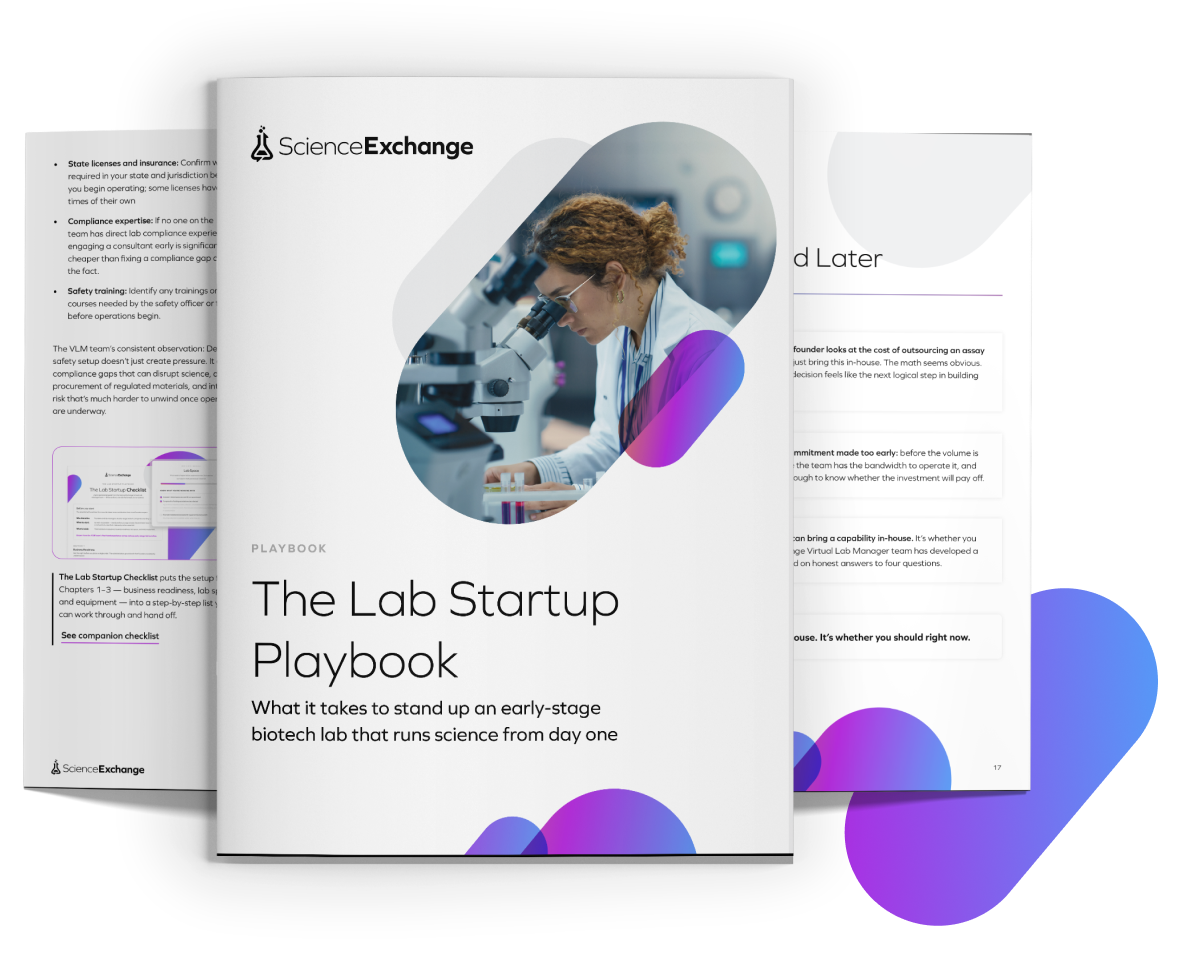
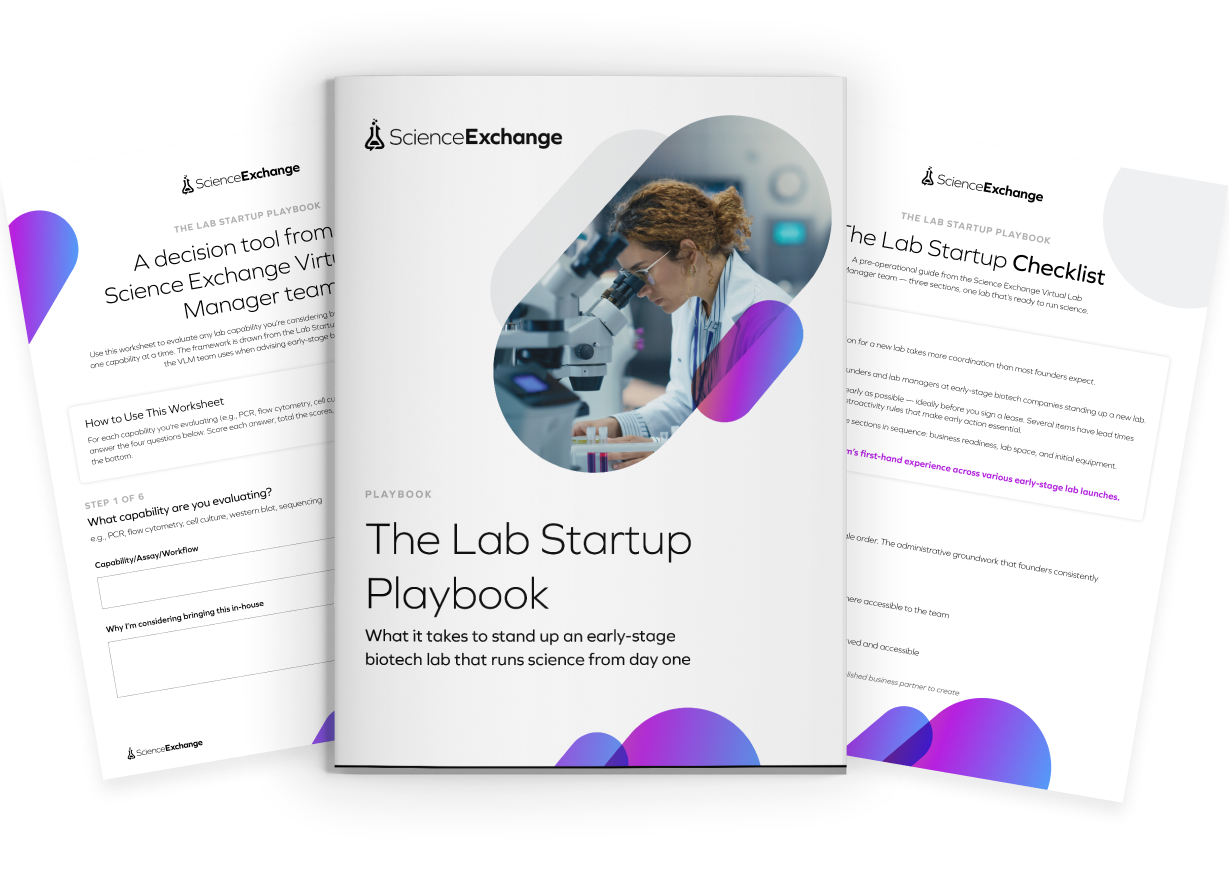
The Lab Startup Playbook

All four chapters packaged as one reference, with the checklist and worksheet built in.

SCIEX - LABSTART - Image - Lab Startup Playbook w. Background1x
SCIEX - LABSTART - Image - Lab Startup Checklist Interactive + PDF1x

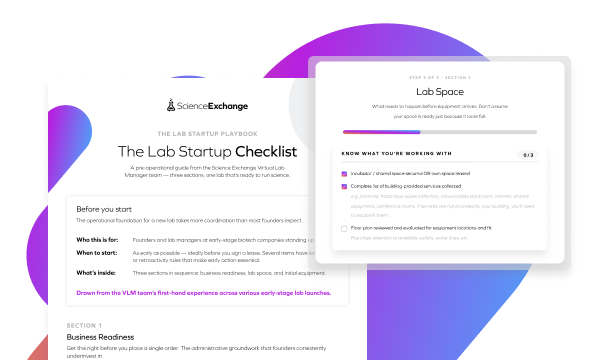
The Lab Startup Checklist

A sequenced checklist mapped to Chapters 1 through 3, covering business infrastructure, space, and the minimal viable lab. Use it to make sure nothing that needs to happen before day one gets missed.

SCIEX - LABSTART - Image - Lab Startup Workbook Interactive + PDF1x

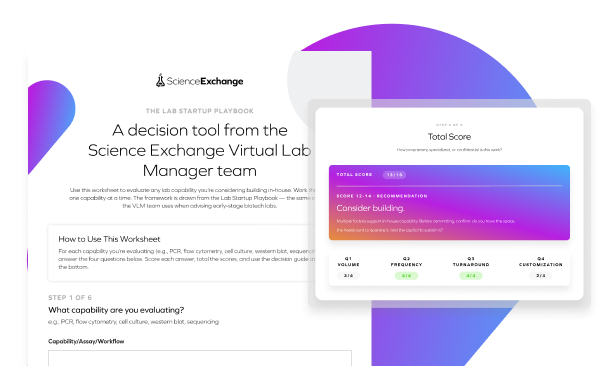
The Lab Startup Workbook

A decision tool mapped to Chapter 4. Run a capability through the VLM criteria, volume, frequency, turnaround, and customization, and get a clear read on whether to outsource it or bring it in-house.

Who the playbook is for

Teams standing up a lab without a dedicated ops person

The Lab Startup Playbook is written for small biotech teams, typically one to five scientists, who are setting up a new lab or scaling one that grew without operational scaffolding. It is most directly useful to founders, scientists in leadership roles, R&D operations leaders, and lab managers at seed through Series B companies who are making procurement and setup decisions themselves.

If you have a dedicated operations or procurement team, the guide still works as a shared reference. If you do not, it works as the operations hire you have not made yet. Existing Science Exchange customers use it to pressure-test setup decisions before they commit budget.

SCIEX - LABSTART - Image - scientist looking in microscope pill gradient1x

Why the Virtual Lab Manager team wrote it

Practitioners who have done this dozens of times

The Lab Startup Playbook comes from the Science Exchange Virtual Lab Manager team, the people who set up and run labs for biotech companies as their day job. The mistakes and patterns in the guide are the ones they watch cost real labs months of runway, so the framing starts with what goes wrong and then shows the sequence that prevents it. This is the same operational experience that sits behind Science Exchange's Virtual Lab Manager service. 

The guide is deliberately vendor-neutral on the parts that should be. It tells you what to set up and how to sequence it, and it is honest that some capabilities are cheaper and faster to outsource until your volume justifies building them, a position backed by how lean biopharma teams actually operate.

SCIEX - LABSTART - Image - production line pill gradient1x

ADDRESSING THE REAL CONCERNS

Questions We Hear Frequently

What comes with the Lab Startup Playbook download?

The download includes the full Lab Startup Playbook guide from the Science Exchange Virtual Lab Manager team, the Pre-Lab Setup Checklist, and the Outsource-vs-Build Worksheet. The guide covers business infrastructure, lab space, equipment essentials, and the outsource-first framework. The checklist and worksheet are practical tools you can use immediately as you set up or scale your lab.

Who should read the Lab Startup Playbook?

The playbook is built for early-stage biotech founders, scientists in leadership, R&D operations leaders, and lab managers at seed through Series B companies who are setting up or scaling a lab without dedicated operations staff. The Science Exchange Virtual Lab Manager team wrote it from direct experience standing up labs, so it is practical rather than theoretical.

Is there a live version of the Lab Startup Playbook?

Yes. The Science Exchange Virtual Lab Manager team is hosting a live webinar on July 9 covering what they have learned standing up labs, with a live Q&A. Registration is free and open to anyone setting up or scaling a lab. Downloading the playbook first means you arrive with the context to ask sharper questions.

Get the Lab Startup Bundle

Download the full guide, the pre-lab checklist, and the outsource-vs-build worksheet in one step, then bring your questions to the VLM team. It is the operational head start most labs figure out the hard way.